How to Make Your Embroidered Biker Patches from Scratch
August 5, 2024
How to Make Sublimation Patches: A Step-by-Step Guide
November 9, 2024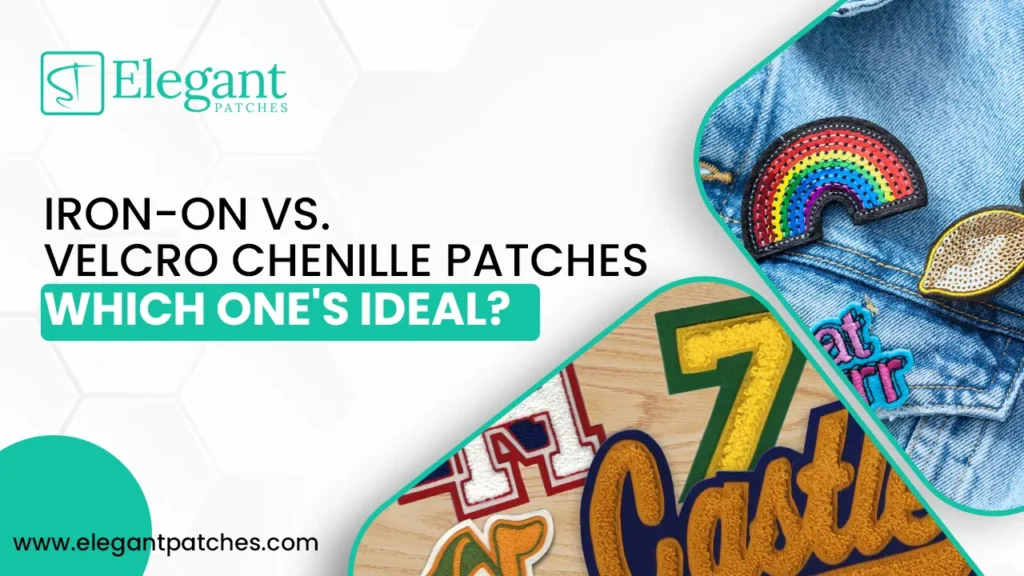
Iron-On vs Velcro Chenille Patches: Which Backing Actually Holds Up?
Quick answer: Iron-on is the right call for chenille patches going on cotton or wool garments you won’t remove often think varsity jackets, hoodies, and caps. Velcro makes sense when the patch needs to come off and go back on, like swappable team gear or tactical bags. The catch with chenille specifically: its thick, plush loop pile behaves differently under both backings than a flat embroidered or woven patch does, and that changes which option actually lasts.
If you’ve been comparing iron-on and velcro for a chenille patch and every article you find just talks about patches in general, that’s the problem. Chenille isn’t embroidery. It’s not woven. It’s a loop-yarn pile stitched onto a felt base, and that construction changes how adhesive bonds to it and how hook-and-loop wears it down. We build custom chenille patches every week at Elegant Patches, so here’s what we’ve actually seen hold up and what doesn’t.
Looking for the general version of this comparison instead? See our breakdown of iron-on vs sew-on patches for backing advice that applies across all patch types, not just chenille.
What Makes Chenille Different From Other Patches
Chenille patches are built from looped yarn stitched densely into a felt backing, which is what gives them that raised, fuzzy, varsity-letter look. That felt base is thicker and heavier than the twill or polyester backing on an embroidered patch, and the yarn pile itself adds bulk on top of it.
That extra thickness and weight matters for backing choice in two specific ways: heat needs longer dwell time to penetrate a thicker felt base, and hook-and-loop velcro grips onto and can catch the yarn loops themselves if the patch sits directly against the hook side without a buffer.
If you’re still deciding between chenille and a flatter alternative before you even get to backing, our chenille vs. embroidered patches comparison is worth reading first.
Iron-On Chenille Patches
Quick answer: Iron-on chenille patches use a heat-activated adhesive film bonded to the felt backing. Press with firm, even heat for 25 to 35 seconds longer than you’d use on a thinner embroidered patch and you get a permanent bond on cotton, denim, and wool. It won’t work on nylon, leather, or anything with a water-resistant coating.
Pros:
- No sewing skill needed
- Clean, flat, permanent finish
- Works well on jackets, hoodies, caps, and bags with a cotton or wool shell
Trade-offs:
- A home iron struggles on patches larger than about 4 inches because chenille’s felt base is thick and holds heat unevenly. For anything bigger, a heat press gives a far more reliable bond.
- On garments washed hard and often think daily workwear the adhesive can start lifting at the felt edges after a couple years. Stitching around the border after ironing fixes that permanently, and it’s a five-minute job.
- Won’t bond to synthetic shells, waterproofed fabric, or leather. Heat just scorches those before the adhesive melts.
We recommend iron-on backing for the majority of chenille orders we ship letterman jackets, Greek life apparel, streetwear drops, and gifts where the customer applies it themselves at home. For the full step-by-step, see how to iron on chenille patches without scorching the yarn pile.
Curious how long that bond actually holds? Here’s what affects how long iron-on patches last under regular wear and washing.
Velcro Chenille Patches
Quick answer: Velcro-backed chenille patches use a hook-and-loop system: the hook side sews onto the back of the patch, the loop side goes on the garment. It’s the right choice when patches need to be swapped, but it requires more setup than iron-on and adds bulk under a thick chenille patch.
Pros:
- Fully removable and reusable
- No heat, no risk to heat-sensitive fabric
- Good for gear that changes patches often tactical bags, uniforms with rotating unit insignia, or seasonal team gear
Trade-offs:
- You need a loop panel sewn onto the garment first. That’s a second step most people don’t expect, and it has to be planned before the garment ships, not added after.
- Because chenille patches already carry thickness from the loop pile and felt base, adding a hook backing stacks even more bulk. On a cap or thin fabric, that can look chunky compared to the same patch iron-on.
- Repeated attach-and-detach cycles can snag stray chenille loops against the hook fastener, especially near the patch edge. It’s not dramatic, but over a couple hundred cycles you’ll notice a slightly fuzzier, worn edge that a purely iron-on patch never develops.
Velcro earns its keep on gear meant to be modular. It’s a worse fit for a one-and-done varsity jacket patch that’s never coming off anyway. This is the standard setup on our tactical patches, morale patches, and airsoft patches those categories are built around swapping designs in and out, which is exactly where velcro chenille makes sense.
Iron-On vs Velcro vs Sew-On: Side-by-Side
| Iron-On | Velcro (Hook & Loop) | Sew-On | |
| Best for | Jackets, hoodies, caps, gifts | Swappable gear, uniforms with rotating patches | Uniforms, heavy daily wash |
| Removable? | No | Yes | No (without unpicking) |
| Extra step needed | None | Loop panel must be sewn on first | Stitching time |
| Works on synthetics/leather? | No | Yes | Yes |
| Bulk on garment | Low | Highest (hook + loop layers) | Low |
| Long-term durability | Strong; reinforce with stitching for heavy wash | Strong for attach cycles; edge wear over time | Strongest overall |
| Typical setup time | Minutes with an iron or heat press | Minutes, once loop panel exists | 10–20 minutes by hand |
Which Backing for Which Use Case
- Varsity and letterman jackets: Iron-on, full stop. It’s permanent, it’s what everyone expects, and it keeps the classic look clean without a hook-and-loop border showing. If you’re planning a full jacket design, our guide to designing varsity jacket patches covers layout and placement too.
- Team or club uniforms with player-specific patches that rotate: Velcro, so numbers or names can swap without re-ordering the whole uniform.
- Hats and caps: Iron-on for most orders, but keep patches under 3.5 inches the curve of a cap and the thickness of chenille don’t play well together above that size regardless of backing.
- Corporate or workwear washed constantly: Sew-on, or iron-on with a perimeter stitch. Adhesive alone won’t survive years of industrial laundering.
- Tactical bags, vests, and gear meant to be personalized on the fly: Velcro, no contest.
- Gifts and merch drops the recipient applies themselves: Iron-on. Nobody wants to hand a customer a needle and thread.
Can You Combine Backings?
Yes, and it’s more common than people expect. The most durable setup for a chenille patch that’ll see hard wear is iron-on adhesive to hold it in place, followed by a straight stitch around the felt border. The adhesive does the positioning work, which makes hand-stitching dramatically easier than pinning a heavy patch in place. You get the clean look of iron-on with the durability of our sew-on patches.
How to Apply Each Backing
Iron-on:
- Set the iron to medium-high, no steam.
- Place the patch, cover with a thin cloth.
- Press firmly for 25–35 seconds, moving slightly to cover the full patch edge.
- Let it cool flat before handling or wearing.
Velcro:
- Confirm the loop panel is already sewn onto the garment.
- Press the patch’s hook backing firmly onto the loop panel.
- Give it a few seconds of firm pressure across the whole surface don’t just tap the center.
Common Mistakes We See
Buyers often order velcro backing without checking their garment already has a loop panel, then discover there’s nowhere to attach it. Others try to iron a chenille patch onto a nylon jacket shell and end up with a scorch mark instead of a bond. And a fair number of people order the smallest possible chenille size with velcro backing, not realizing the hook layer adds enough bulk to make a 1.5-inch patch look almost twice as thick as the same size in iron-on.
FAQ
Can chenille patches be iron-on?
Yes. It’s the most common backing we ship on chenille patches, and it works well on cotton, denim, and wool. It won’t bond to nylon, leather, or waterproof coated fabric.
Does velcro damage chenille patches over time?
Not immediately, but repeated attaching and detaching can cause slight fraying at the yarn loops closest to the hook backing after heavy use. It’s a cosmetic wear pattern, not a structural failure.
Can you iron on a velcro-backed patch?
No. Velcro backing is sewn on, not heat-activated. If you want both removability and no sewing, that combination doesn’t exist yet pick one.
What’s the best backing for a letterman or varsity jacket?
Iron-on, reinforced with a perimeter stitch if the jacket gets heavy wear. This is the traditional application and what most letterman jacket makers expect.
How do you remove an iron-on chenille patch without damaging the fabric?
Apply heat again to soften the adhesive, then peel slowly from one corner. Some adhesive residue may remain; a bit of rubbing alcohol usually lifts it.
Can chenille patches be washed?
Yes, but turn the garment inside out and wash on a gentle cycle. Avoid high heat drying, which can flatten or mat the yarn pile over time.
Does backing choice change the price?
Usually yes, though the difference is modest. Velcro backing costs slightly more than iron-on because it requires an extra sewing step during production. See our breakdown of what custom patches typically cost for a fuller picture, or check current pricing on your quote before ordering.
What size limits apply to velcro-backed chenille patches?
There’s no hard size cap, but on anything under 2 inches, the combined bulk of chenille pile plus hook backing starts to look disproportionate. For small patches, iron-on keeps the profile cleaner.
Bottom Line
For most chenille patch orders jackets, hoodies, caps, one-time gifts iron-on is the simpler, cleaner, more permanent choice. Reach for velcro only when the patch genuinely needs to come off and go back on. If you’re not sure which fits your project, tell us what the patch is going on and how often it’ll change hands, and we’ll point you to the right backing before you order.
Ready to build yours? Start with our custom chenille patches page, or send us your artwork through our vector artwork services if it needs cleanup first.