PVC vs Silicone Patches – What’s the Difference?
August 4, 2026
Woven Patch vs Embroidered Patch – Which One Is More Durable?
September 19, 2026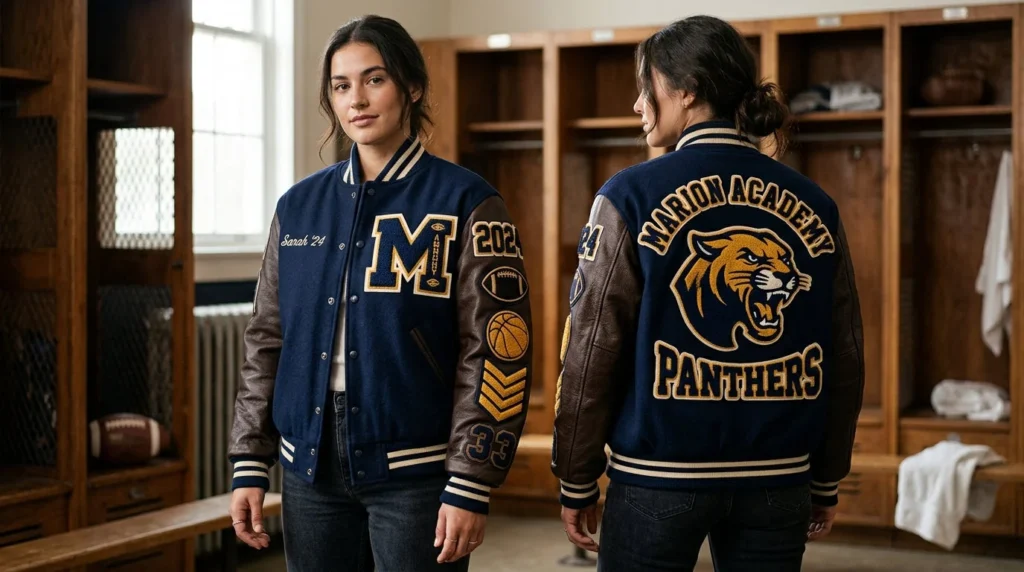
Varsity Jacket Patches: How to Design, Size and Place Them
Quick answer: Varsity jacket patches are usually chenille, sewn on with a felt backing. A classic layout puts one large letter on the left chest, a name or number on the right, a bigger design on the back, and small patches on the sleeves. Keep the artwork bold, since fluffy chenille can’t hold fine detail.
Most people planning varsity jacket patches get stuck in the same place. The jacket is bought, the idea is there, and then the questions pile up. How big? Where do they go? Chenille or embroidery? What file does the manufacturer want?
Here’s the version we’d give you if you walked into a patch shop with a jacket over your arm.
Where do patches go on a varsity jacket?
Quick answer: Traditionally, the main letter sits on the left chest, with the wearer’s name or number on the right chest. Large mascot or school designs go on the back. Sleeves carry sports, awards, class year or club patches. Keep it balanced: one hero patch, not five competing ones.
Layouts vary by school and team, but this pattern is the safe starting point:
- Left chest: the school letter or initial. This is the patch people notice first.
- Right chest: name, nickname or number. It can be much smaller.
- Back: the big statement piece. A mascot, school name arc, or number.
- Left sleeve: sport, activity or team.
- Right sleeve: graduation year or class.
- Extras: chevrons, bars, stars and achievement pins go near the letter or on the lower sleeve.
Lay the jacket flat and place paper cutouts at real size before you order anything. Photograph it. You’ll spot crowding straight away.
What size should varsity jacket patches be?
Quick answer: Chest letters commonly run about 6 to 10 inches (15 to 25 cm), back designs 10 to 14 inches (25 to 35 cm), and sleeve patches 2 to 4 inches (5 to 10 cm). Always size against the actual jacket. A patch that suits an adult XL can swamp a youth or women’s small.
These are typical ranges, not rules. A few habits keep you out of trouble:
- Measure the flat panel, not the whole jacket. Seams, pockets and zips eat space.
- Check what “size” means. With chenille, some suppliers measure only the chenille, and the finished patch with its felt border ends up larger. Confirm before you order. For a deeper dive, see our standard patch size guide.
- Mind minimum letter height. Chenille text much under an inch tall turns to mush. Many manufacturers set about 30mm as the floor.
- Ask for a mockup at true scale. A logo that looks crisp on a monitor can be unreadable at four inches.
Chenille or embroidered patches for a varsity jacket?
Quick answer: Use chenille for the main letter, numbers and big shapes, because its raised loops read from across a field. Use embroidery for small text, names, thin outlines and detailed logos. Many jackets mix both, sometimes inside one patch.
Chenille is the varsity look. It’s thick, soft and bold. The trade-off is precision. Tiny gaps close up and thin lines disappear.
| Chenille | Embroidered | Woven / PVC / leather | |
| Look | Raised, fluffy, vintage | Flat, sharp thread detail | Fine detail (woven), rubbery (PVC), premium (leather) |
| Best on a varsity jacket for | Letters, numbers, back designs | Names, positions, small logos | Modern or streetwear builds |
| Fine detail | Poor | Good | Woven very good |
| Min. readable text | Around 1 in (about 30mm) | Much smaller | Varies |
| Typical backing | Felt, sewn on | Sew-on, iron-on, Velcro | Sew-on or adhesive |
| Common mistake | Overloading with detail | Making it too small to see | Using stiff PVC on soft wool |
If you’re pairing them, keep it simple. Chenille for the letter and year, flat embroidery for names and small marks. It looks unified and it keeps the price down. For more on the trade-offs, read our breakdown of which patches make the best jacket patches.
How to design varsity jacket patches that actually work
Quick answer: Start with one bold idea, limit yourself to three or four colors, simplify the artwork, and choose one main font. Send vector artwork if you have it. Approve a mockup at actual size before production starts.
Here’s the process we’d follow:
- Decide what the patch says. School letter? Team? Year? Achievement? One patch, one message.
- Simplify the artwork. Turn a detailed mascot into strong shapes. Push the small stuff to embroidered outlines or skip it.
- Pick colors with contrast. If it’s part of a uniform, match the official scheme. Otherwise, make sure the letter contrasts with its border and the jacket body. Navy on black looks great on a mood board and vanishes in daylight.
- Choose one main font. A bold athletic block letter with one script for a name is plenty. Three type styles look chaotic.
- Prepare your file. Vector formats (AI, EPS, PDF, SVG) are best. A clean high-resolution PNG can work. If you only have a phone photo of a sketch, that’s fine too. A designer can rebuild it.
- Approve a proof. Check spelling, spacing, colors and scale. This is where mistakes get caught cheaply.
Ready to see it built? Our custom chenille patches page has the options, or you can send artwork for a free look. Elegant Patches advertises no minimum order, so a single patch is fine.
What backing should you choose?
Quick answer: Sew-on is the standard for varsity jackets and the most durable. Iron-on suits light cotton but can damage leather and wool blends. Velcro works for removable patches. Adhesive is short-term only. On a wool-and-leather jacket, stitch the wool and use a fabric adhesive or careful hand-sewing on the leather.
- Sew-on (felt back): permanent, strong, the traditional choice.
- Iron-on: quick, but heat and thick chenille don’t always agree. Test first, and never iron directly onto leather.
- Velcro: handy for swappable patches on teams and clubs.
- Adhesive: for events and temporary use.
Attachment matters more than most people think. A perfect patch stitched badly will bulge or pucker. If you’re unsure, take the jacket to a tailor or dry cleaner who does alterations. It’s usually a modest fee.
Real-world uses
Quick answer: Varsity patches aren’t just for high school. Schools, colleges, sports clubs, bands, bike crews, brands, event teams and streetwear labels all use them, and the same design rules apply.
- US high schools and colleges: letterman jackets with letter, sport, year and achievement patches. Awards get added over the years.
- UK universities, societies and school leavers: varsity-style and baseball jackets for sports clubs, Greek-inspired societies, and leavers’ merch. UK buyers usually think in cm and mm, so ask for the mockup in both units.
- Clubs and bikers: chenille back patches and small rockers. Check our blog on embroidered biker patches before you commit.
- Brands and merch: limited-run jackets where one chenille hero patch carries the whole look. If you’re weighing the cost, see whether chenille is economical for brands.
- Military-adjacent and units: these tend to use embroidered or woven Velcro patches, not chenille, so check the dress code first.
What affects the price?
Quick answer: Size, number of colors, how much embroidery sits on the chenille, backing type, quantity and rush timing all move the price. Bigger, more detailed patches cost more. Ordering several of the same design usually lowers the per-patch cost.
That’s why quotes from different suppliers differ so much. Send the same artwork and the same target size to each shop to compare fairly. For a full breakdown, see how much custom patches cost.
Common mistakes to avoid
- Ordering before measuring the jacket panel.
- Putting fine text or thin lines in chenille.
- Using too many colors. Three or four is plenty.
- Skipping the proof.
- Ironing onto leather or wool blends without testing.
- Cramming too many patches on the front.
- Forgetting that small print looks different across a room.
Look at your design from across the room, then up close. If it only works at one distance, simplify it.
How to care for a jacket with chenille patches
Quick answer: Spot-clean when you can, and dry-clean when you can’t. Don’t machine-wash a varsity jacket. Hang it on a shaped hanger, keep it away from direct heat, and brush chenille gently to lift the pile.
Wool, leather and chenille all hate agitation. Check the jacket’s care label first, and tell your dry cleaner about the patches.
FAQs about varsity jacket patches
- What are varsity jacket patches usually made of?
Chenille on a felt base, often with embroidered details or outlines. It’s the raised, fluffy look most people picture. - Where does the letter go on a letterman jacket?
Traditionally the left chest. The name or number usually goes on the right. - Can I put iron-on patches on a varsity jacket?
On plain cotton sections, sometimes. On wool blends and leather, it’s risky. Sewing is safer and lasts longer. - How big should a back patch be?
Roughly 10 to 14 inches (25 to 35 cm) wide for an adult jacket, scaled to fit the panel. Get a true-scale mockup first. - Can I order just one chenille patch?
Elegant Patches advertises no minimum order. Confirm on your quote. - What file format is best for custom chenille patches?
Vector files (AI, EPS, PDF, SVG) are ideal. A clear PNG or JPG is often workable, and a designer can rebuild rough sketches. - Can I wash a varsity jacket with chenille patches?
Not in a machine. Spot-clean or dry-clean, and let it air dry. - Chenille or embroidery for a varsity jacket?
Chenille for big letters and shapes, embroidery for small text and detail. Many jackets use both.
Ready to order your varsity jacket patches?
Good varsity jacket patches come down to four things: bold artwork, the right size for your jacket, sensible placement, and a proper backing. Get those right and the patch will outlast the jacket.
Have artwork or just a rough idea? Send it to us and we’ll come back with a mockup. Start with our custom chenille patches or explore the full custom patch range.